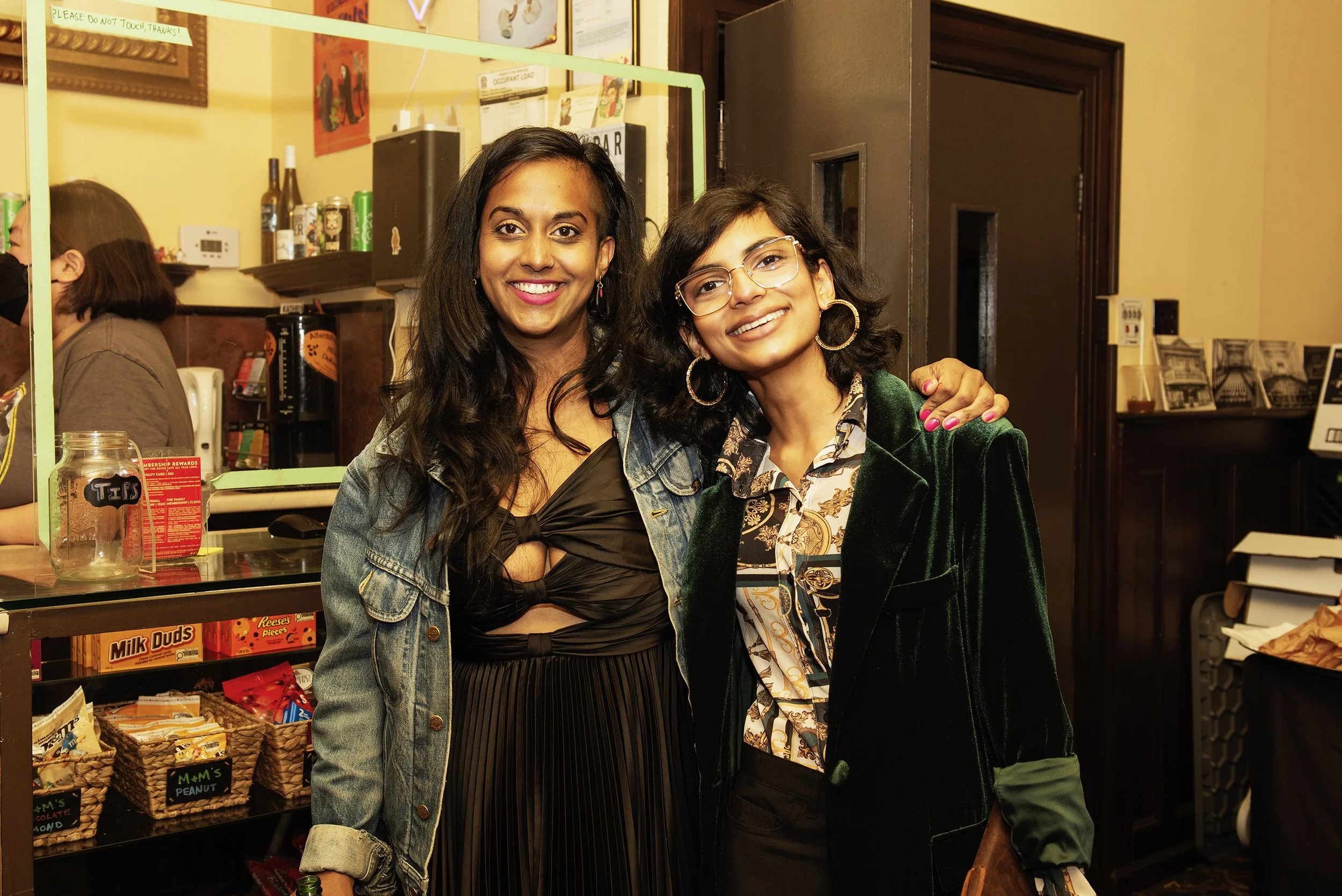
Nikki Shaffeeullah and Shaharah Gaznabbi
Photo by Duane Cole
Navigating Purgatory through community:
an interview with writer-director Nikki Shaffeeullah
By Shaharah Gaznabbi
In 2022-2023 I experienced loss unlike anything I thought I would ever face. In the span of 6 months, being 19 years old turning 20, I lost one of my closest high school friends, and then both of my grandparents on my fathers side, the latter in the span of 10 days. 10 days apart were their deaths, and at the time, family and funeral directors alike would assure me that death this close in proximity was a sign of the purest love; my grandfather’s soul leaving this earth one week before my grandmothers to embrace her as she joined him. Their earthly bodies being buried, essentially, in the same grave.
Funeral as ritual was a whiplash nobody in my family expected nor experienced before, especially in the specific ways Indo-Caribbean Muslim funerals tend to be different from your average “everyday” funeral.
Indo-Caribbean Islam can feel like, and I choose this word deliberately, a ‘purgatory’ between our culture as we know and celebrate it now, and the version of our religion and culture that has been stripped away or lost or colonised through the hardships of indentureship. But I never, honestly, mourn what our religious values could have been, because moving through these ‘traditional’ rituals during these funerals made me see how progressive my family was, in a way I would never have seen under less morbid circumstances.
The Janazah, for example, is the Islamic death prayer which is recited before the body is lowered into the ground. Traditionally, the men must stand in front of the women during this prayer.
As my Grandfather and Grandmother birthed two girls and one boy (my father), and each of those children birthing daughters, other than my brother and ½ of myself (as a non-binary darling), our family is predominantly women. The men in question who attended these funerals were extended uncles and spouses of people whom I couldn’t even name.
“Nope! We aren’t going to do that!” My aunt, my dad’s sister yelled when the young Imam asked for the men and women to separate. It was the rainiest day in April, and the ceiling of black umbrellas made the canopy of grief even more imposing.
“If you do not separate,” he started, stating very clearly, not mincing his words, “the prayer will not be valid, so I will not perform it for you unless you do it right”.
We were wet and cold— our socks drenched from the downpour. Our frustration all boiled into the melting pot of emotions that was already ever present amidst our grief.
“Whatever” scoffed my aunt, and we obeyed. With a wall of broad shouldered men I couldn’t name in dark jackets in front of me, I didn’t see my grandfather's casket during the Janazah.
“It’s okay” a voice whispered beside me. “At the end of the day, they follow a version of this religion that was written in a book by men hundreds of years ago.” An aunty I had never met instantly became my favourite person there. She was a family friend/aunty (which in the Caribbean we have a ton of, I promise), who came with her sister who later found me at the wake after the funeral which was held at my house.
“Have you ever heard of the unity mosque?” She asked me. I hadn’t, but I was intrigued and very glad this aunty clocked my queerness without even knowing me!
“They are a queer friendly mosque where they don’t separate people by gender. It is a truly safe space, and even has female Imams!” These sister aunties became my heroes, and I credit them as the people who opened my eyes to the coexistence I found I could have within my queerness as well as as a Muslim. That wouldn’t have happened without this funeral, and although it was traumatic and so so sad for our family, I am proud to have been able to walk away with that valuable of an experience.
When I first screened Purgatory, I was sat on the floor of the writer-director Nikki Shaffeeullah’s apartment with her beautiful child toddling about, occasionally sitting on my lap. I was set to host the Toronto invited screening of the film later that month and had a strategy meeting with Nikki earlier that day.
In watching the film, the first thing I noticed was how much it transported me back to 2023. The rain, the colours vivid in the shots despite the lack of sun. The film felt like a memory for me, and captured the ritual of funeral I had undergone in a way I had never seen portrayed.
The wake after the funeral where everyone is sat along the walls of the living room eating pholourie and fried rice. The mix of hijabi uber-traditional aunties whose husbands were very scared of my 12-pound miniature dachshund puppy, and, at least in my case, the predominantly queer younger generation I am lucky to have in my family. These demographics were forced to mush together through this ritual of funeral in a purgatory in of itself. A blend of understanding, misunderstanding, inherent familial love, and resentment towards those who hold opposing values.
No piece of art, and no film in particular, had ever captured that specific nuance for me before. That’s why, even months after watching the film in a theatre full of our community members, the images from Purgatory still resonate meaningfully in my mind.
It seems silly to say, but I saw my life reflected onscreen in a way I had genuinely never felt, and the blend of realism, grief, and the intersection of queer Indo-Caribbean Islam made it feel, for the first time, that my world could exist in the medium of a film for others to begin to comprehend.
“It was a project that I picked up and put down a lot over a few years. It really started in 2020, and it was because I wasn’t able to do theatre because of lockdowns”. Nikki Shaffeeullah is someone who I value as a mentor. I look up to her dearly, and respect her as a theatre creator, activist, and community leader. It was the greatest privilege to have the opportunity to sit down with her and ask her about her experience creating this film.
“The impulse to write this film came as I was reflecting on a few real life incidents of either grief or crisis, in the meeting places of very ritualised cultural spaces and the day-to-day life of being a person who happens to be queer in those spaces.
The story came to me very quickly which was also a very fun experience. I was procrastinating from working on the play script of A Poem for Rabia. Writing that was such a different process - I wrote it very very slowly and iteratively with lots of workshops and community conversations.
I ended up “cheating” on that project when I was supposed to be finishing a draft of it. I just kind of sat down and wrote the first draft of Purgatory in one sitting, which had never happened to me before. It’s not my style as a writer to just pour it out, but I think that is part of why it became very exciting. Maybe it was something about the mechanism of a short film– the story just felt very clear to me.”
I have huge levels of respect for writers who are able to have a story wash over them then immediately sit down and write an impactful story chronologically in one go at their first impulse– especially as it is completely different to my own process as a writer, and it was refreshing to hear how different it was to her process as well.
I spoke with Nikki about that specific resonance I felt while watching the film, as it captured an experience I had never seen portrayed with the nuance Purgatory offered.
“There’s almost a trope in queer muslim stories, or other queer stories about people who are from hypervisible minoritized communities that the West loves to hate– the stories are often about being a fish out of water, and trauma, and these “incompatible” parts of oneself.
It was important to me that this story wasn’t that. I often find those narratives tired and frustrating, and they don’t feel true to my experience. I think it’s much more interesting to explore the complexities of being in the spaces, where there are tensions and incongruities, but also where those are woven into life with or nuanced, and perhaps more settled conflicts.”
Purgatory has been a very special project, as it has been touring around the country with community-based screenings (supported by the Inspirit Foundation’s New Narrative fund), reaching cities such as Toronto (where I hosted the screening), Vancouver, Calgary, Montreal, and Halifax, as well as festivals around Canada and most recently Chicago. Nikki shared what the process of touring and engaging in a new artistic field has been like for her.
“The screening tour has been such a cool experience… I work predominantly in theatre and I’m only beginning to dabble in the independent film world. Learning a new artistic craft and industry has been funny to do in my 30s. I started working in theatre in my early 20s and so from a young age began internalising what you “should” and “shouldn’t do”, artistically and professionally. Doing that again as a fully formed adult who had professional experience elsewhere has felt interesting. I’m learning the craft of filmmaking, but also at the same time, the industry norms. Those actually make sense because I have other industry experience to compare it to. It’s not theoretical, it's not scary or intimidating, I can understand it without it being emotional. But this time, I am confident in not wanting to internalize those typical industry anxieties, the competition, the behavioural pretenses that one can feel pressured to take on. I also made this film on the precipice of becoming a parent - we shot it when I was six months pregnant, and started post-production when I was five months postpartum. And the film itself involved a lot of non-professionals from my family - my nieces and cousin and parents and siblings and sister-in-law and aunt were all involved in various ways. I loved making this film, and I'd love to make more films, but it’s not the kind of thing or time in my life where “I need to do this at all costs”. It’s not more important to me to have a certain kind of success, than it is to have a balanced life with my friends and family. Centering that in both the process of making, and in the community-based approach to distribution, has felt that kind of liberating.”
If there is anything that I have taken away from Nikki as a mentor and as an artist I hope to emulate the work of, it is her community engagement. Nikki Shaffeeullah is someone who is always thinking about the community impact within her art, and does the work to ensure that not only is a demographic represented on stage/screen, but meaningfully engaged with offstage/screen with equal weight.
“I was thinking about the experience and the process for me and for others… I couldn’t have made it without a lot of community. It’s the kind of project I really liked being able to make because of the relationships of community and family and friends. It is set at a Guyanese Muslim funeral, so I needed lots of extras that looked like they could be there. It isn’t the easiest in the extra pool to find in the Greater Toronto Area, older racialised South Asian, Black,a nd other racialized folks, especially lots of women. But we did find some, and they were all so wonderful. I also tapped into family and communty - my aunties, Roya (director of photography) got her parents to come - It was kind of fun to build in that way, too.”
She continued with this sentiment, proving where her and her team hoped to focus their values as producers from the beginning of this process.
“The New Narratives prize from the Inspirit Foundation… really allowed us to concoct a path forward for sharing the film that was just totally rooted in our own values and joy – we focused on doing a run of screenings coast to coast, where we invited community, friends, queer organizations, and just any people who may enjoy the film. We partnered with local arts organisations who I already had relationships with who I knew had shared values and really similar approaches to curating performance spaces, to invite folks from their networks. We kept everything free, had delicious food and in some cases, local performances, poets in particular. The event was really kind of bringing artists together in live space to respond to each other creatively and that felt really nice.
I just wanted everyone who attended to feel like a VIP, which they are. If as a producer you think of yourself as a host, and you really prioritize audiences feeling comfortable and that their needs are met, it can transform what a performance feels like.”
This article was a pleasure to write as a celebration of the film and everything that went into it. Every single beautiful soul that has touched this film has been wonderful, whether they were part of the crew, a performer, an extra, a caterer, or an audience member in any of the incredible cities this film has been presented at.
It is a beautiful opportunity to continue supporting art that wishes to support us. Art that doesn’t focus on capital growth but rather using the resources they are given to uplift and strengthen the individuals they wish to give focus and love to.
This is just the beginning for Purgatory, and I cannot wait to see how it continues to develop as it touches the hearts of many many more people.